

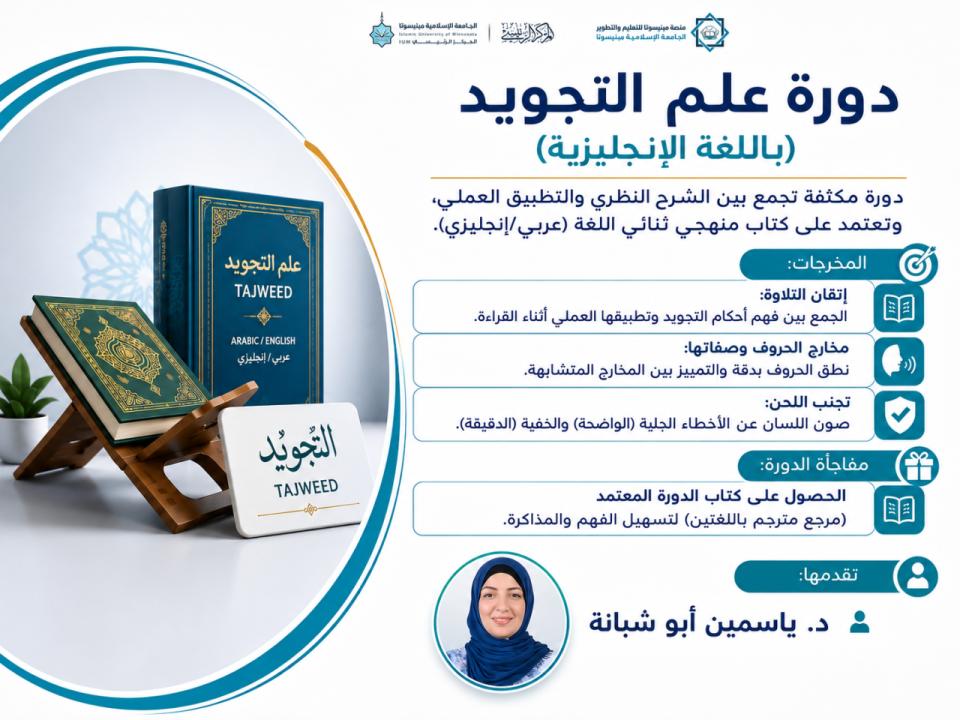
عن هذه الدورة
تتناول الدورة المحاور الأربعة الأساسية لعلم التجويد بدءاً من مخارج الحروف المحققة والمقدرة وكيفية التمييز بين الحروف المشتركة في المخرج من خلال صفاتها الذاتية. كما تشمل دراسة أحكام الحروف والتفخيم والترقيق والتطبيق العملي القائم على تكرار التلاوة وتدريب عضلة اللسان، فضلاً عن تصنيف أخطاء التلاوة إلى لحن جلي ولحن خفي. وأخيراً، توضح الدورة الأوجه الجائزة لقراءة الاستعاذة والبسملة في أوائل السور وبين السورتين وأوجه الربط مع سورة التوبة.
مخرجات التعلم
- الفهم الدقيق للفرق بين تعلم التجويد كعلم نظري (فرض كفاية) والتطبيق العملي له أثناء التلاوة (فرض عين).
- المعرفة الدقيقة بمخارج الحروف وصفاتها لتفادي الوقوع في اللحن الجلي واللحن الخفي.
- إتقان أوجه قراءة الاستعاذة والبسملة عند بدء السور أو بين السورتين وحالات الاستثناء كبداية سورة التوبة.
- تلاوة القرآن الكريم بصورة صحيحة ومتقنة تحاكي قراءة النبي صلى الله عليه وسلم.
متطلبات الدورة
- الرغبة والالتزام بتعلم أحكام تجويد القرآن الكريم وتطوير التلاوة باللغة الإنجليزية.
- توفر نسخة من المصحف الشريف للمتابعة الفردية والتطبيق أثناء المحاضرات.
- الالتزام بمواعيد الجلسات (مرتين أسبوعياً لمدة شهر تقريباً) ومتابعة الكتاب المقرر عبر مجموعة الواتساب.
- الاستعداد للتكرار والممارسة العملية المستمرة لتدريب عضلة اللسان على النطق الصحيح.
منهج الدورة
-
Theoretical and Practical Course Methodology
-
Tajweed: Linguistic and Technical Definition
-
Purpose of Tajweed and Preservation of Recitation
-
Legal Ruling on Learning and Applying Tajweed
-
The Four Pillars of Tajweed Mastery
-
Lahn Jali: Clear Recitation Errors
-
Lahn Khafi: Subtle Recitation Errors
-
Isti‘adhah: Meaning and Legal Basis
-
Cases for Silent Isti‘adhah
-
Cases for Audible Isti‘adhah
-
Interruption and Repetition Rules
-
Basmalah: Status and Quranic Placement
-
Four Permissible Ways to Begin a Surah
-
Beginning Recitation from the Middle of a Surah
-
Basmalah Between Consecutive Surahs
-
Transition from Al-Anfal to At-Tawbah
-
Letter and Makhraj: Core Definitions
-
Locating the Makhraj Using Hamzah and Sukun
-
Specific and Approximate Articulation Points
-
Definition, Types, and Major Divisions of Articulation Points
-
Al-Jawf and the Madd Letters
-
Throat Divisions and Practice with Vowels and Sukūn
-
Deepest Throat: Hamzah and Hā’
-
Middle Throat: ‘Ayn and Ḥā’
-
Nearest Throat: Ghayn, Khā’, and Throat-Articulation Review
-
Teeth and Tongue Divisions Related to Articulation
-
Articulation of Qāf: Tafkhīm and Qalqalah
-
Articulation of Kāf: Hams and Shiddah
-
Middle of the Tongue: Jīm, Shīn, and Non-Madd Yā’
-
Articulation of Ḍād from the Sides of the Tongue
-
Articulation of Lām: Heavy and Light Pronunciation
-
Articulation of Nūn and Ghunnah
-
Articulation of Rā’ and Differentiating Lām, Nūn, and Rā’
-
General Review and Articulation-Practice Plan
-
Articulation of Ṭā’, Dāl, and Tā’
-
Articulation of the Whistling Letters
-
Articulation of Ẓā’, Dhāl, and Thā’
-
Review of Tongue Articulation Points
-
Articulation Points of the Lips
-
Pronunciation of Fā’, Wāw, Bā’, and Mīm
-
The Nasal Cavity and Ghunnah
-
Comprehensive Review of Articulation Points
-
Distinguishing Between ‘Ayn and Ghayn
-
Pronunciation Correction and Tafkhīm
-
Classification of Letters by Articulation Points
-
Progressive Teaching of Tajweed
-
Definition and Importance of Letter Characteristics
-
Permanent and Conditional Characteristics
-
Al-Hams: Whispering and Flow of Breath
-
Al-Jahr: Prevention of Breath Flow
-
Ash-Shiddah: Complete Stoppage of Sound
-
Ar-Rikhāwah: Continuation of Sound
-
At-Tawassut: Moderation Between Shiddah and Rikhāwah
-
Practical Application of Sound Flow Levels and Teaching Guidelines
-
Recap of Al-Hams & Al-Jahr (Whispering & Audibility)
-
Al-Shiddah, Al-Rakhawah, & Al-Tawassut (Strength, Softness & Moderation)
-
Timing Comparison of Sakin Letters Based on Sound Qualities
-
Al-Isti'la & Al-Istifal (Elevation & Lowering of the Tongue)
-
Al-Itbaq & Al-Infitah (Adhesion & Openness of the Tongue)
-
Al-Idhlaq & Al-Ismat (Fluency & Restraint)
-
Al-Safeer (Whistling): Its Letters, Makhraj & Natural Sound
-
Al-Qalqalah (Echoing): Concept, Levels & Avoiding Common Pitfalls
-
Al-Leen (Softness): Letters, Articulation & Relation to Madd
-
Al-Inhiraf (Deviation): Mechanism and Application in Lam & Ra
-
Al-Takreer (Repetition) & Al-Tafash-shee (Spreading)
-
Al-Istitalah (Elongation): Articulating Dad vs. Heavy Dal
-
Table Analysis for Extracting and Combining Letter Characteristics
-
Classification of Characteristics: Strong vs. Weak Characteristics
-
The Core Importance of Studying Letter Characteristics in Tajweed
-
Definition and Forms of Tanween
-
Introduction to Vowels: Fatha, Damma, and Kasra
-
Noon of Tawkeed Exception
-
Al-Izhar Al-Halqi Rule and Its Letters
-
Idgham: Definition and Classifications
-
Idgham with Ghunnah Yanmoo
-
Idgham without Ghunnah
-
Absolute Izhar and Idgham Exceptions
-
Al-Iqlab Rule and Applications
-
Definition of Real Ikhfa and its Letters
-
Rules of Ikhfa Ghunnah: Tafkheem and Tarqeeq
-
Applied Examples of Real Ikhfa
-
Performance Notes: Ikhfa with Vowels
-
Introduction to Meem Sakinah Rules
-
Idgham Shafawi: Small Mutamathilayn
-
Ikhfa Shafawi and its Relation to Iqlab
-
Izhar Shafawi and Warning Letters
-
Introduction to Madd and Qasr
-
Main Categories of Madd: Natural and Secondary
-
The Three Letters of Madd and Their Conditions
-
Natural Madd: Definition and Duration
-
Introduction and Causes of Secondary Madd
-
Obligatory Connected Madd (Al-Madd Al-Muttasil)
-
Permissible Detached Madd (Al-Madd Al-Munfasil)
-
Exchange Madd (Madd Al-Badal)
-
Presentation Sukoon Madd (Madd Al-Arid Lis-Sukoon)
-
Introduction to Compulsory Madd and Its Divisions
-
Compulsory Heavy Verbal Madd (Al-Madd Al-Lazim Al-Kalimi Al-Muthaqqal)
-
Compulsory Light Verbal Madd (Al-Madd Al-Lazim Al-Kalimi Al-Mukhaffaf)
-
Opening Letters of Surahs and Groupings
-
Compulsory Heavy Literal Madd (Al-Madd Al-Lazim Al-Harfi Al-Muthaqqal
-
Compulsory Light Literal Madd (Al-Madd Al-Lazim Al-Harfi Al-Mukhaffaf)
-
General Review and Summary of Madd Rules
-
Exam
إحصائيات التقييمات
جاري تحميل التقييمات...