

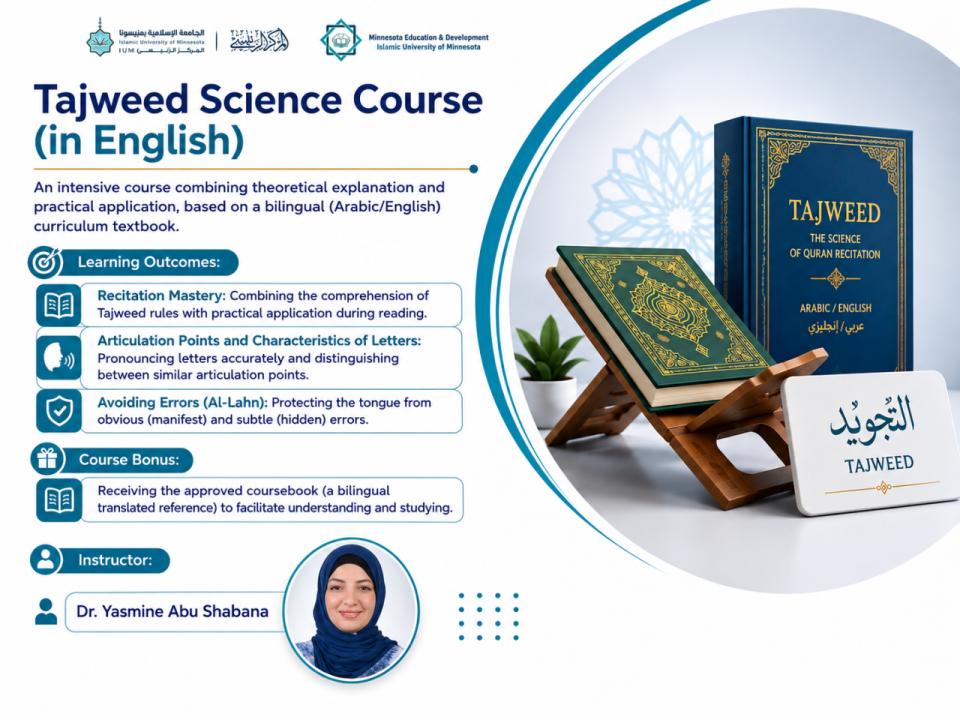
About This Course
The course covers the four essential aspects of Tajweed science, starting from the accurate and approximate articulation points of letters and how to distinguish between letters that share the same articulation point based on their inherent characteristics. It also includes the study of letter rules, emphasis and softening, along with practical application based on repeated recitation and training the tongue muscles. Furthermore, it classifies recitation errors into clear and subtle mistakes. Finally, the course clarifies the permissible ways of reciting the seeking refuge (ista'adhah) and the opening phrase (Basmala) at the beginning of the chapters and between chapters, as well as their connection with Surah At-Tawbah.
Learning outcomes
- A precise understanding of the difference between learning Tajweed as a theoretical science (a communal obligation) and its practical application during recitation (an individual obligation).
- An accurate knowledge of the articulation points of letters and their characteristics to avoid falling into clear and hidden mistakes.
- Mastery of the modes of reciting the refuge and the opening phrases at the start of surahs or between surahs, including exceptional cases like the beginning of Surah At-Tawbah.
- Reciting the Holy Quran accurately and perfectly, emulating the way the Prophet Muhammad (peace be upon him) read.
Course Requirements
- The desire and commitment to learn the rules of Quranic recitation and improve recitation in English.
- Availability of a copy of the Quran for individual follow-up and practice during lectures.
- Commitment to the session timings (twice a week for approximately one month) and following the required book through the WhatsApp group.
- Readiness for repetition and continuous practical exercises to train the tongue muscle for correct pronunciation.
Course Curriculum
-
Theoretical and Practical Course Methodology
-
Tajweed: Linguistic and Technical Definition
-
Purpose of Tajweed and Preservation of Recitation
-
Legal Ruling on Learning and Applying Tajweed
-
The Four Pillars of Tajweed Mastery
-
Lahn Jali: Clear Recitation Errors
-
Lahn Khafi: Subtle Recitation Errors
-
Seeking Refuge: Meaning and Legal Basis
-
Cases for Silent Isti‘adhah
-
Cases for Audible Isti‘adhah
-
Interruption and Repetition Rules
-
Basmalah: Status and Quranic Placement
-
Four Permissible Ways to Begin a Surah
-
Beginning Recitation from the Middle of a Surah
-
Basmalah Between Consecutive Surahs
-
Transition from Al-Anfal to At-Tawbah
-
Letter and Makhraj: Core Definitions
-
Locating the Makhraj Using Hamzah and Sukun
-
Specific and Approximate Articulation Points
-
Definition, Types, and Major Divisions of Articulation Points
-
Al-Jawf and the Extended Letters
-
Throat Divisions and Practice with Vowels and Sukūn
-
Deepest Throat: Hamzah and Hā’
-
Middle Throat: ‘Ayn and Ḥā’
-
Nearest Throat: Ghayn, Khā’, and Throat-Articulation Review
-
Teeth and Tongue Divisions Related to Articulation
-
Articulation of Qāf: Thickening and Echoing
-
Articulation of Kāf: Hams and Shiddah
-
Middle of the Tongue: Jīm, Shīn, and Non-Madd Yā’
-
Articulation of Ḍād from the Sides of the Tongue
-
Articulation of Lām: Heavy and Light Pronunciation
-
Articulation of Nūn and Ghunnah
-
Articulation of Rā’ and Differentiating Lām, Nūn, and Rā’
-
General Review and Articulation-Practice Plan
-
Articulation of Ṭā’, Dāl, and Tā’
-
Articulation of the Whistling Letters
-
Articulation of Ẓā’, Dhāl, and Thā’
-
Review of Tongue Articulation Points
-
Articulation Points of the Lips
-
Pronunciation of Fā’, Wāw, Bā’, and Mīm
-
The Nasal Cavity and Ghunnah
-
Comprehensive Review of Articulation Points
-
Distinguishing Between ‘Ayn and Ghayn
-
Pronunciation Correction and Tafkhīm
-
Classification of Letters by Articulation Points
-
Progressive Teaching of Tajweed
-
Definition and Importance of Letter Characteristics
-
Permanent and Conditional Characteristics
-
Al-Hams: Whispering and Flow of Breath
-
Al-Jahr: Prevention of Breath Flow
-
Ash-Shiddah: Complete Stoppage of Sound
-
Ar-Rikhāwah: Continuation of Sound
-
At-Tawassut: Moderation Between Severity and Leniency
-
Practical Application of Sound Flow Levels and Teaching Guidelines
-
Recap of Al-Hams & Al-Jahr (Whispering & Audibility)
-
Al-Shiddah, Al-Rakhawah, & Al-Tawassut (Strength, Softness & Moderation)
-
Timing Comparison of Sakin Letters Based on Sound Qualities
-
Al-Isti'la & Al-Istifal (Elevation & Lowering of the Tongue)
-
Adhesion & Openness of the Tongue
-
Fluency & Restraint
-
Al-Safeer (Whistling): Its Letters, Articulation & Natural Sound
-
Al-Qalqalah (Echoing): Concept, Levels & Avoiding Common Pitfalls
-
Al-Leen (Softness): Letters, Articulation & Relation to Madd
-
Al-Inhiraf (Deviation): Mechanism and Application in Lam & Ra
-
Al-Takreer (Repetition) & Al-Tafash-shee (Spreading)
-
Al-Istitalah (Elongation): Articulating Dad vs. Heavy Dal
-
Table Analysis for Extracting and Combining Letter Characteristics
-
تصنيف الخصائص: خصائص قوية مقابل خصائص ضعيفة
-
The Core Importance of Studying Letter Characteristics in Tajweed
-
Definition and Forms of Tanween
-
Introduction to Vowels: Fatha, Damma, and Kasra
-
Noon of Tawkeed Exception
-
The Al-Izhar Al-Halqi Rule and Its Letters
-
Idgham: Definition and Classifications
-
Assimilation with Nasalization Yanmoo
-
Idgham without Ghunnah
-
Absolute Izhar and Idgham Exceptions
-
The Iqlab Rule and Its Applications
-
Definition of Real Ikhfa and its Letters
-
Rules of Ikhfa Ghunnah: Tafkheem and Tarqeeq
-
Applied Examples of Real Ikhfa
-
Performance Notes: Ikhfa with Vowels
-
Introduction to Meem Sakinah Rules
-
Idgham Shafawi: Small Similar Letters
-
Ikhfa Shafawi and its Relation to Iqlab
-
Izhar Shafawi and Warning Letters
-
Introduction to Madd and Qasr
-
Main Categories of Madd: Natural and Secondary
-
The Three Letters of Madd and Their Conditions
-
Natural Madd: Definition and Duration
-
Introduction and Causes of Secondary Madd
-
Obligatory Connected Madd (Al-Madd Al-Muttasil)
-
Permissible Detached Madd (Al-Madd Al-Munfasil)
-
Exchange Madd (Madd Al-Badal)
-
Presentation of Sukoon Madd (Madd Al-Arid Lis-Sukoon)
-
Introduction to Compulsory Madd and Its Divisions
-
Compulsory Heavy Verbal Madd (Al-Madd Al-Lazim Al-Kalimi Al-Muthaqqal)
-
Compulsory Light Verbal Madd (Al-Madd Al-Lazim Al-Kalimi Al-Mukhaffaf)
-
Opening Letters of Surahs and Groupings
-
Compulsory Heavy Literal Madd (Al-Madd Al-Lazim Al-Harfi Al-Muthaqqal)
-
Compulsory Light Literal Extension (Al-Madd Al-Lazim Al-Harfi Al-Mukhaffaf)
-
General Review and Summary of Madd Rules
-
Exam
Reviews Statistics
Loading reviews...