

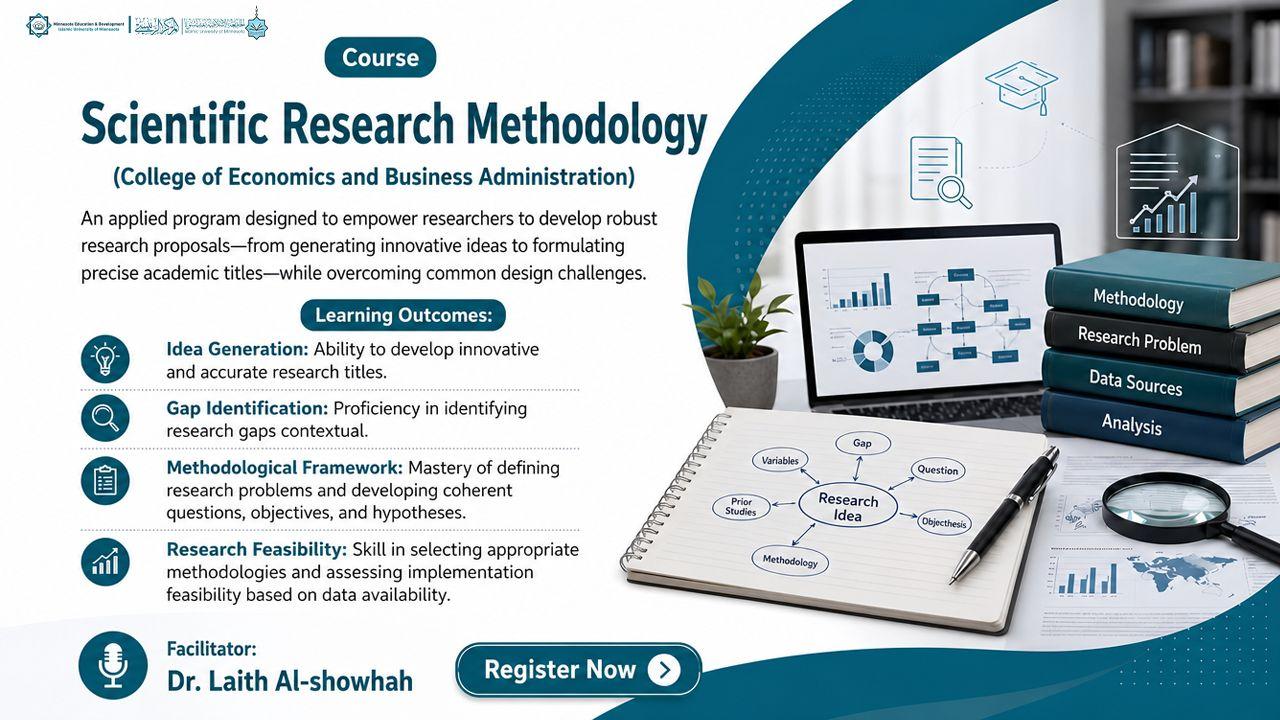
About This Course
This course focuses on the methodology of transforming research ideas into solid scientific studies, starting from identifying problems and research gaps to constructing the conceptual model. The course also addresses the mechanisms of crafting the academic title, linking theories to research, and ensuring the measurability of variables and the availability of data to ensure the proposal's success. Additionally, the course provides advanced strategies for critical reading of previous literature, enabling researchers to uncover gaps and untapped research opportunities in traditional topics.
Learning outcomes
- The ability to generate an innovative research idea and formulate it into an accurate academic title.
- The ability to identify research gaps and classify them (contextual, methodological, theoretical, or in variables).
- Mastering the formulation of the research problem and developing associated questions, objectives, and hypotheses.
- The ability to select appropriate methodologies and assess the feasibility of the research idea in light of data availability.
Course Requirements
- Familiarity with the fundamentals of scientific research and academic writing tools.
- Identifying a general research interest area (such as financial technology or management) to develop further.
- Ability to access databases and previous studies in the researcher's field.
- Willingness to engage in scientific critique and comparative analysis of research ideas.
Course Curriculum
-
The Research Idea and Sources of the Research Idea
-
The Research Gap and the Four Types of Research Gaps and How to Professionally Identify Them.
-
Research Recommendations: How to Extract Them and Convert Them into Ideas
-
Problems and Changes in the Business and Economic Environment
-
Data and the Three Stages
-
Stages of Title Engineering (Idea, Defining the Relationship, Scientific Depth, and Final Formulation)
-
Understanding Independent and Dependent Variables and Identifying Cause-and-Effect Relationships
-
For the parameter variable: its function and how to add it to the research model
-
The Modified Variable: Its Function and How to Add It to the Research Model
-
Constructing the Research Problem (Issue, Real-World Problem, and Knowledge Gap)
-
Linking Research Questions, Objectives, and Hypotheses (Disaggregation and Comparison Principle)
-
Research Hypotheses and Their Connection to Questions and Objectives
-
Building the Theoretical Framework and Employing Theories to Interpret Relationships Between Variables
-
The Test
Reviews Statistics
Loading reviews...