

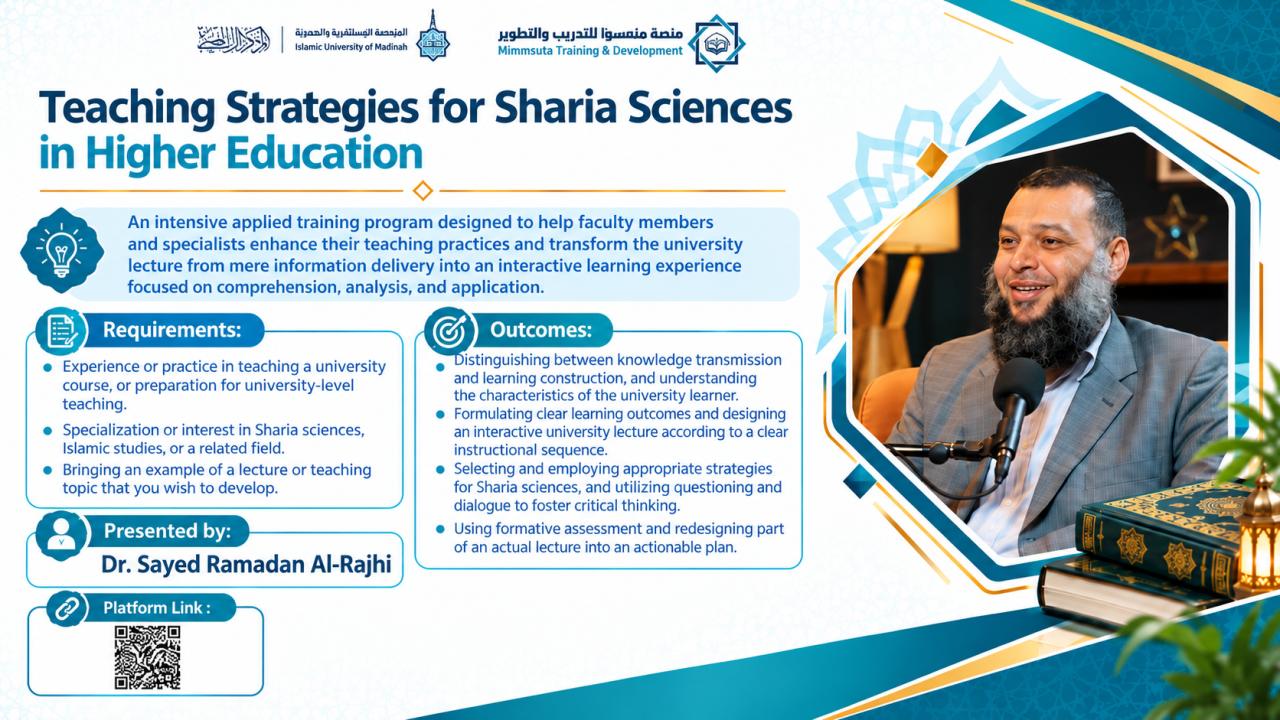
About This Course
A specialized training course aimed at developing the skills of faculty members in teaching Islamic sciences by transitioning from passive lecturing methods to interactive and deep teaching strategies. It focuses on designing the university learning environment to maximize the impact of Islamic knowledge in shaping learners' behavior and their practical skills.
Learning outcomes
- Distinguishing between the model of passive education and the model of interactive and deep learning in the field of Islamic sciences.
- The ability to formulate observable and measurable learning objectives and outcomes that go beyond merely listing information.
- Employing interactive teaching strategies suitable for large numbers of students in university lecture halls.
- Designing integrated steps for an effective lecture or lesson that include preparation, provoking thought, building knowledge, and development and assessment.
Course Requirements
- Basic familiarity with the requirements for academic and university teaching of Islamic sciences.
- A genuine desire to develop and update methods of delivering Islamic knowledge to students.
- Commitment and active participation in the activities and discussions presented during meetings.
- Care to relate religious texts to contemporary reality and practical applications.
Course Curriculum
-
Is every distinguished scientist a distinguished teacher?
-
The Importance of Not Overlooking Pedagogical Skills and Comparing Models
-
The Five Roles of an Effective University Professor
-
From Passive Learning to Interactive and Deep Learning
-
The Learner's Mind and Its Six Essential Needs for Learning
-
The Concept of Deep Learning and Learning Outcomes
-
Transforming Topics into Measurable Learning Outcomes
-
Modern Learning Theories and the (AIGS) Neuroscience Framework
-
Steps to Plan Building an Effective Lecture
-
Six Quick Interactive Ideas and Strategies
-
Applying the Five Key Questions to Prepare the Lesson
-
Understanding Learning Experience
-
Understanding Learning Experience Design: Models and Differences Between Them
-
Conversational Framework Model
-
Active Deep Learning Experience Model (First)
-
Criteria for Choosing the Strategy and the (C-Model)
-
Strategies for Dialogue, Discussion, and Analysis of Legal Texts
-
Case Study Strategies and Problem Solving
-
Collaborative Learning and Inquiry-Based Learning
-
Rapid Assessment Tools and Measuring Learning Impact
Reviews Statistics
Loading reviews...