

About This Course
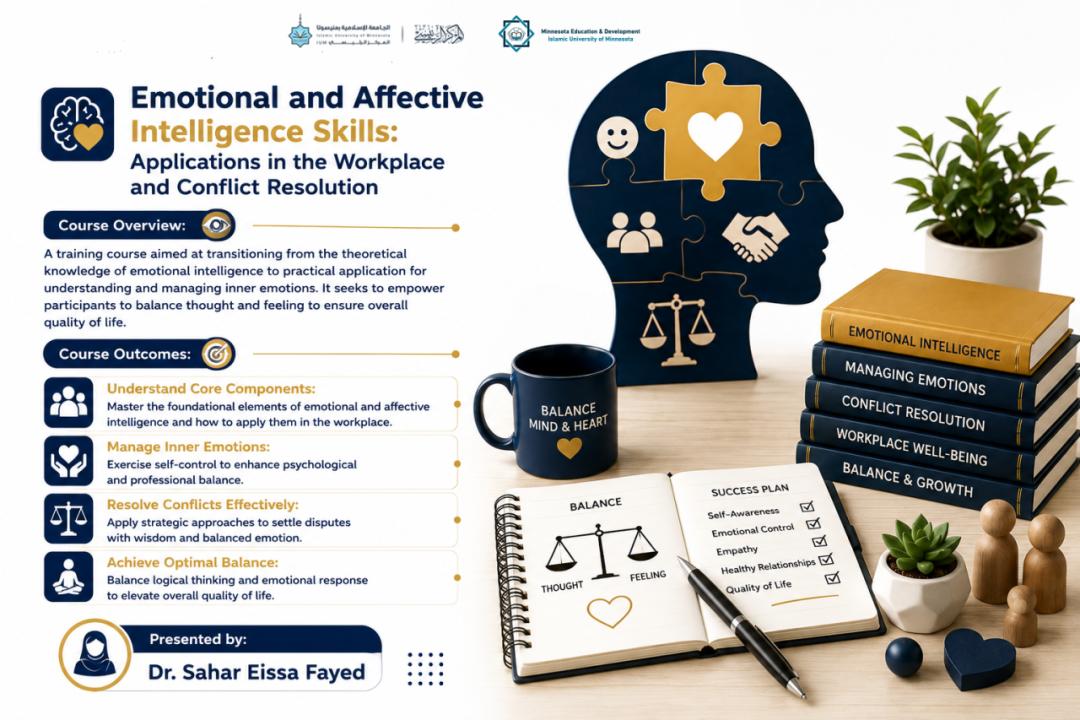
This course explores the evolution of the concept of intelligence from the traditional perspective (IQ) to Howard Gardner's theory of multiple intelligences, with a strong focus on emotional intelligence as a cornerstone for professional and social success. The course addresses how to decode human self-awareness, manage immediate emotional responses, and improve relationships with others through effective communication skills and smart empathy. Participants will learn tools to measure emotional intelligence and how to leverage it in making sound decisions and navigating workplace challenges with resilience.
Learning outcomes
- Recognize the importance of practicing emotional intelligence skills in understanding internal feelings and responding wisely to situations.
- Differentiate between the eight types of human intelligences and identify personal strengths.
- Ability to manage social and professional relationships effectively to reduce conflicts.
- Master the comparison between cognitive and emotional intelligence to achieve a balance in behavior and actions.
Course Requirements
- The desire to develop communication skills and self-awareness.
- The ability to participate in interactive and analytical activities.
- Commitment to attending the scheduled training hours (two hours per session)
Course Curriculum
-
Leading with Compassion and Emotional Intelligence in the Quran: An Analytical Study of the Conflict between Mind and Emotion Based on Real Case Studies
-
The Pyramid of Major Relationships: Self, Creator, and Others
-
The Nature of Intelligence and the Ability to Respond Appropriately
-
Traditional Logical Intelligence (IQ) and Its Limitations
-
Howard Gardner's Theory of Multiple Intelligences
-
Linguistic and Mathematical Logical Intelligence (Skills of Expression and Digital Reasoning)
-
Interactive and Environmental Intelligences (Social, Auditory, Spatial, and Environmental)
-
The Nature of Emotional Intelligence and Its Core Components (Self-integration and Social Integration)
-
Managing Immediate Emotions and Traits of a Sage Person
-
Measures of Emotional Intelligence and the Fundamental Differences Between IQ and EQ
-
Emotional Intelligence vs. Logical Intelligence: Which One Leads to Excellence?
-
Psychology of Change: How to Develop Our Emotional Skills?
-
Introduction to Conflict Analysis (The Bermuda Triangle Model in Relationships)
-
Roles of the Drama Triangle: Victim, Rescuer, and Persecutor
-
Strategies for Breaking Free from the Negative Cycle and Taking Responsibility
-
Balancing Human Values with Practical Goals
-
Individual Behavior Analysis: The Open and Blind Areas
-
Behind the Mask: Discovering Treasures in the Unknown Area
-
Personality Dynamics: Developing Dominant Traits and Self-Description
-
Brain Dominance Styles and Their Relationship to Emotional Intelligence (Herrmann Model)
-
Cultural Intelligence (CQ): The Art of Dealing with Diversity in the Workplace
-
Conflict Management and Strategies for Influence and Persuasion
-
Course Test
Reviews Statistics
Loading reviews...