

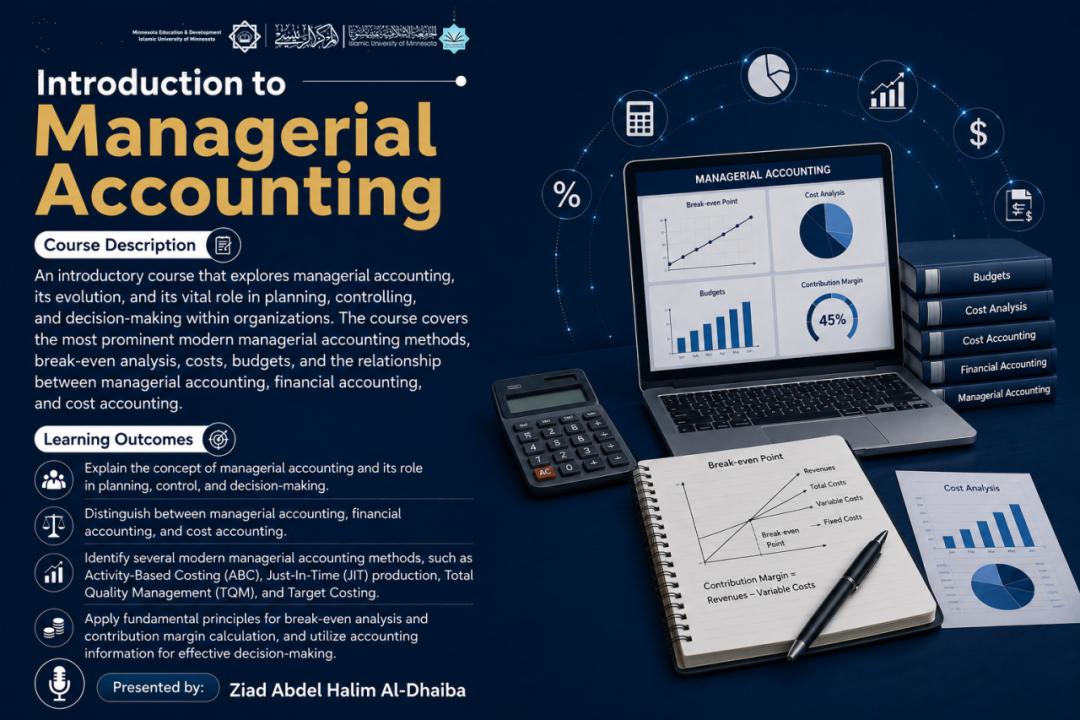
About This Course
The course provides a comprehensive introduction to managerial accounting, highlighting its role in planning, control, and decision support, while comparing it to financial and cost accounting. It discusses modern methods such as Activity-Based Costing (ABC), Just-In-Time (JIT) production, Total Quality Management, and target costing. The course includes practical applications for analyzing break-even points, fixed and variable costs, and contribution margins to evaluate organizational performance. It also emphasizes the historical development of accounting and the contributions of Islamic civilization to the foundations of accounting thought.
Learning outcomes
- Explain the concept of managerial accounting and its role in planning, control, and decision-making.
- Differentiate between managerial accounting, financial accounting, and cost accounting.
- Identify several modern methods of managerial accounting, such as ABC, JIT, total quality management, and target costing.
- Apply the basic principles of break-even analysis, calculate contribution margin, and utilize accounting information in decision-making.
Course Requirements
- It is not required for the trainee to specialize in accounting.
- Familiarity with the basic concepts of revenues, expenses, and costs is preferred.
- Ability to perform basic calculations and percentages.
- Willingness to apply numerical examples related to costs and breakeven points.
Course Curriculum
-
Introduction to Managerial Accounting and Course Highlights
-
The Historical Development of Accounting and the Role of Islamic Civilization
-
Budgeting and Its Role in Planning and Control
-
The Concept of Managerial Accounting and Its Relationship with Management and Information Systems
-
Activity-Based Costing and Just-In-Time Production
-
Total Quality Management, Target Costing, Zero Defects, and Flexible Manufacturing Systems
-
Factors Affecting Information and Definition of Managerial Accounting
-
The concept of the break-even point and its importance in decision-making
-
Fixed and Variable Costs, Contribution Margin, and Break-Even Point Applications
-
Practical Application of Break-even Point and Using Information in Decision Making
-
Budgets, Variance Analysis, and Comparison between Managerial and Financial Accounting
-
The Role of the Management Accountant, Information Systems, and the Relationship Between Cost Accounting and Management Accounting
-
The Test
Reviews Statistics
Loading reviews...