

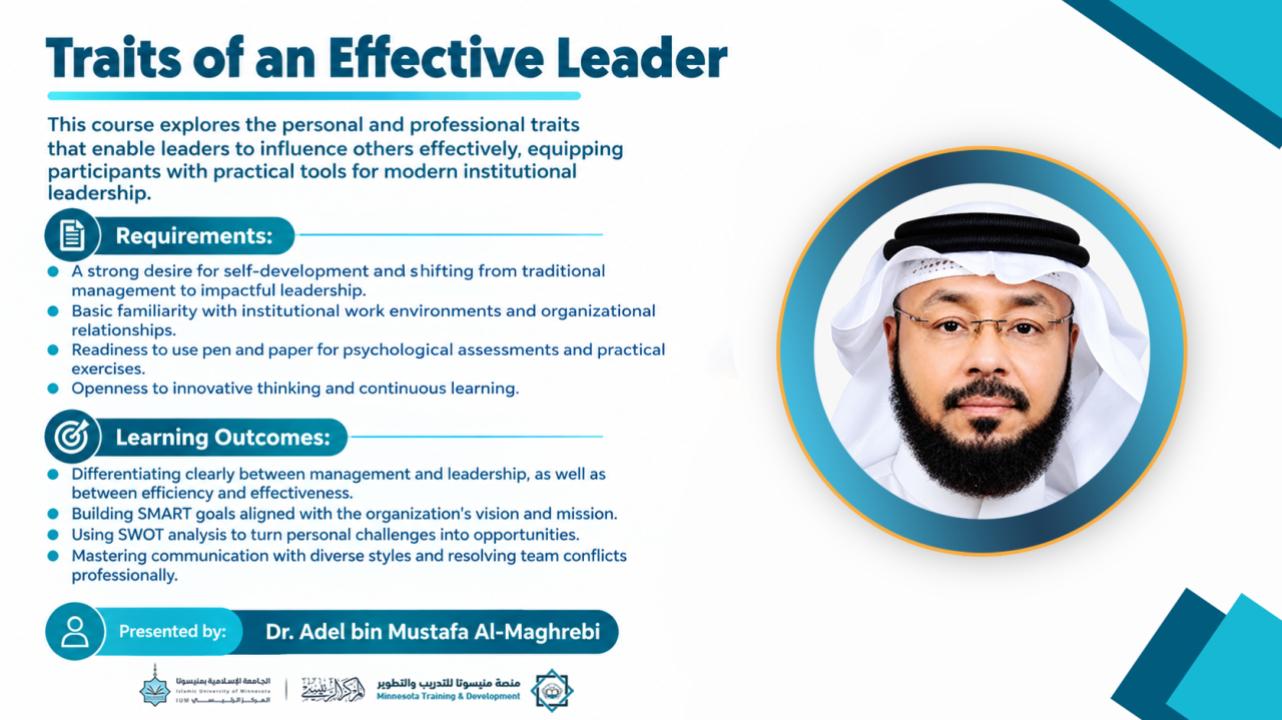
About This Course
The course addresses the concept of effective leadership beyond traditional authority, focusing on how a leader builds their character through the triangle of "knowledge, skill, and behavior." Participants will learn how to formulate vision and smart goals, how to use a prioritization matrix to manage time effectively, as well as understanding human patterns and dealing with organizational conflicts. This course targets anyone striving for professional excellence, as it provides practical value through applied models such as SWOT analysis and empowerment strategies, helping to translate theoretical objectives into tangible results that serve the organization's vision.
Learning outcomes
- Clearly differentiate between management and leadership, as well as between the concepts of efficiency and effectiveness.
- The ability to construct a SMART (Specific, Measurable, Achievable, Relevant, Time-bound) objectives matrix aligned with the institution's vision and mission.
- Analyze personal potentials using the SWOT matrix to convert weaknesses into opportunities.
- Master communication skills with different representational styles and resolve conflicts within the team professionally.
Course Requirements
- A serious desire for self-development and transitioning from a traditional management style to an effective leadership style
- A basic understanding of the institutional work environment and the nature of the relationship between the employee and the organization.
- Willingness to use writing tools (paper and pen) to implement psychological measures and practical exercises
- An open mind to adopt out-of-the-box thinking strategies and continuous learning
Course Curriculum
-
Definition of Management and the Difference Between Efficiency and Effectiveness
-
The Concept of Leadership, Linguistically and Terminologically
-
The Interrelationship Between the System and the Employee
-
First Attribute: Goal, Vision, and Mission
-
The Second Theme: Challenge, Risk Management, and SWOT Analysis
-
Thinking Outside the Box and Its Importance for the Leader
-
The Third Attribute: Empowerment and Delegation Authority
-
Exploring the Representational Patterns of the Team
-
Time Management and Priorities (Eisenhower Matrix)
-
The Balance and Continuous Growth of the Leader
-
Black and Mouton Models for Conflict Resolution and Crisis Management
-
Self-Confidence, Self-Esteem, and Shaping Future Leaders
-
The Test
Reviews Statistics
Loading reviews...